
SEO, or Search Engine Optimization, is the practice of improving a website’s visibility on search engines like Google so that more people can find it organically — without paying for ads. It combines technical setup, quality content, and credibility signals to help a site rank higher for relevant search queries. Whether you run a small local shop or a global brand, SEO determines how discoverable you are online.
Why SEO Matters More Than Ever in 2026-27
Every single second, Google processes over 99,000 search queries worldwide. People search before they buy something. They search before they book a hotel. They search before they trust a business. If your website does not show up when someone searches for what you offer, you simply do not exist for that person at that moment.
This is not an exaggeration. It is the reality of how people discover businesses, services, and information today.
Paid advertising is one solution — but it has a fundamental weakness. The moment your ad budget runs out, your visibility disappears completely. SEO, when built correctly and consistently, keeps delivering results over months and years without a recurring cost per click. That compounding, long-term return is the reason businesses of every size — from solo freelancers to multinational corporations — invest seriously in understanding and implementing it.
Consider this: organic search drives more than 50% of all website traffic across industries, according to data consistently referenced in digital marketing research. No other single channel comes close to that figure at scale. Social media traffic is volatile and algorithm-dependent. Email requires an existing list. Direct traffic requires existing brand awareness. Organic search captures people at the exact moment they are actively looking for what you have — and that is an incomparably powerful position to be in.
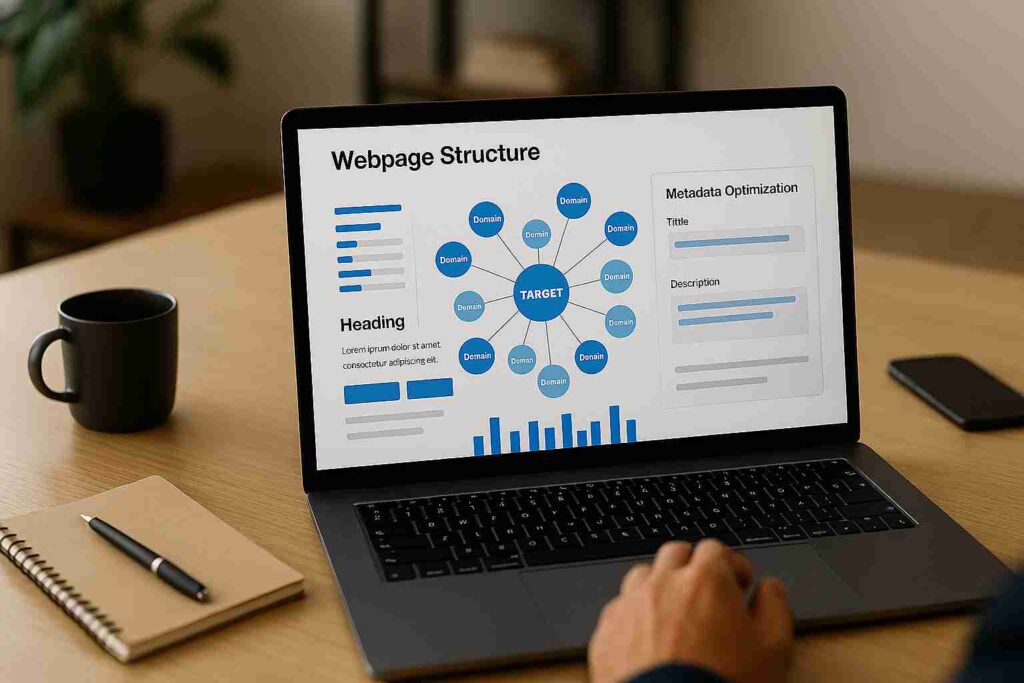
What Search Engine Optimization Actually Means
The phrase “search engine optimization” gets repeated so often it starts to feel abstract. Let us be precise about what it actually involves, from the ground up.
A search engine like Google uses automated programs called crawlers — sometimes called spiders or bots — to continuously discover web pages across the internet. These programs follow links from page to page, reading the content on each one. Those pages are then indexed, meaning they are stored and categorized in a massive database that Google maintains.
When someone types a query into Google’s search bar, the search engine does not search the live internet in real time. It searches its own index — that enormous database of pages it has already crawled and stored. The algorithm then evaluates all the pages in the index that are relevant to that query and ranks them based on hundreds of signals and factors to determine which pages best answer what the user is looking for.
SEO is your deliberate effort to help search engines understand your pages better, demonstrate that your content is genuinely trustworthy and relevant, and earn the ranking position your content deserves. It is not about tricking algorithms or gaming the system. It is about creating a genuine alignment between what users need and what your content delivers — and then making sure search engines can recognize and reward that alignment.
Think of it this way. Google’s job is to provide the best possible answer to every query its users type. Your job, as an SEO practitioner, is to make sure that when a query is relevant to your business or content, your page is the best possible answer available. When you genuinely achieve that, ranking follows naturally.
The Three Core Pillars of SEO
Every SEO strategy — regardless of industry, business size, or target market — rests on three interconnected pillars. Understanding these pillars separately is useful. Understanding how they work together is what actually produces results.
Neglect any one of these three pillars and your results will plateau, no matter how well you execute on the other two.
Pillar One: Technical SEO
Technical SEO covers everything that makes it possible for search engines to find, access, crawl, and index your website properly. It is the foundation beneath everything else. If a crawler cannot access your pages, or if your site is too slow to load properly, nothing else matters — your content will never rank regardless of how well-written it is.
Think of technical SEO as the plumbing and wiring of a building. Nobody sees it directly, but without it working correctly, the building cannot function.
Site Speed and Core Web Vitals
Google officially made Core Web Vitals a direct ranking signal. These are a set of three specific performance metrics that measure the real-world experience of loading and interacting with a page.
The first metric is LCP, or Largest Contentful Paint. This measures how long it takes for the largest visible element on a page — usually an image or a large block of text — to fully load. Google’s target is under 2.5 seconds. Pages that load their main content in under 2.5 seconds are considered good. Between 2.5 and 4 seconds is considered needs improvement. Above 4 seconds is considered poor.
The second metric is INP, or Interaction to Next Paint, which replaced the older FID metric. This measures how quickly the page responds when a user interacts with it — clicking a button, tapping a menu, typing in a field. The target is under 200 milliseconds.
The third metric is CLS, or Cumulative Layout Shift. This measures how much the visual layout of a page shifts unexpectedly while loading — for example, when an image loads and pushes all the text down, causing you to click the wrong link. The target score is under 0.1.
You can check your site’s Core Web Vitals performance for free using Google PageSpeed Insights and Google Search Console.
Mobile-Friendliness
Google has operated on a mobile-first indexing basis for several years now. This means Google predominantly uses the mobile version of your website to determine rankings — even for desktop searches. A site that works perfectly on desktop but breaks on mobile will be ranked based on its broken mobile version. Every page on your site must be fully responsive and functional on all screen sizes.
HTTPS and Security
HTTPS — the secure version of the standard web protocol — has been a lightweight ranking signal since Google confirmed it in 2014. Beyond rankings, it builds user trust. Browsers now flag non-HTTPS sites as “Not Secure,” which damages credibility and increases bounce rates. Every website should be running on HTTPS with a valid SSL certificate.
Crawlability and Indexation
For Google to rank a page, it must first be able to crawl it and then choose to index it. Several technical configurations can accidentally block this from happening. Your robots.txt file tells crawlers which parts of your site they are and are not allowed to access. Meta robots tags on individual pages can instruct search engines not to index specific pages. Pages that are only accessible after login cannot be crawled. Pages with no internal links pointing to them — called orphaned pages — are rarely discovered.
Regularly auditing your site’s crawlability using Google Search Console’s Coverage report is essential. This report shows you exactly which pages are indexed, which are blocked, and which have errors preventing indexation.
Site Architecture and URL Structure
The way your website is structured matters. A logical, flat architecture — where most important pages are reachable within two or three clicks from the homepage — is easier for crawlers to navigate and tends to perform better in rankings. Deep hierarchies, where important content is buried five or six levels below the homepage, risk being crawled infrequently or insufficiently.
URLs should be short, descriptive, and where natural, include the target keyword. Avoid long strings of numbers, dynamic URL parameters, or session IDs in your crawlable URLs. A URL like yoursite.com/what-is-seo is far better than yoursite.com/page?id=2847&session=abc123.
Pillar Two: On-Page SEO
On-page SEO is about the quality, relevance, and structure of the content on each individual page. It is where search intent meets execution. This is the pillar that most people associate with SEO — writing content, using keywords, structuring pages — and while it is absolutely essential, it only works if the technical foundation beneath it is solid.
The Title Tag
The title tag is the clickable headline that appears in Google’s search results. It is one of the most influential on-page elements for both rankings and click-through rates. It should contain your primary keyword naturally, stay under 60 characters to avoid being cut off in search results, and be compelling enough that someone would choose to click your result over the competing results listed above and below it.
Writing a good title tag is a skill in itself. It needs to signal to both the search engine and the user that your page directly addresses what they are looking for.
The Meta Description
The meta description is the short paragraph of text that appears beneath your title in search results. Google does not use it as a direct ranking signal, but it has a significant impact on whether someone clicks. A well-written meta description reads like a compelling preview of your page — it should include the primary keyword, stay under 160 characters, and speak directly to what the user will find if they click.
Write meta descriptions for humans, not for algorithms.
Header Structure
Every page should have one H1 tag — the primary topic headline that tells both users and search engines what the page is fundamentally about. Below that, H2 tags introduce major sections, and H3 tags introduce subsections within those H2 sections. This hierarchical structure helps users scan the page efficiently and helps crawlers understand the information architecture.
Content Depth and Quality
There is no universally correct word count for ranking on Google. The right length is whatever it takes to fully and satisfyingly answer the user’s query better than every competing page in the search results. Some queries are completely answered in 400 words. Others — like an authoritative guide on a complex topic — require 5,000 words or more to provide genuine, comprehensive value.
The mistake many people make is chasing a word count target rather than focusing on whether the content actually answers the question. Thin content that does not satisfy intent will not rank regardless of how long it is. On the other hand, well-researched, genuinely helpful content naturally tends to be longer because covering a topic comprehensively requires space.
Keyword Placement
Your primary keyword should appear in the title tag, the H1, the first paragraph, naturally throughout the body, and ideally in at least one subheading. The emphasis here is on “naturally.” Forcing keywords into sentences where they do not fit is called keyword stuffing, and it actively harms both user experience and rankings. Write for your reader first — if your content genuinely covers the topic, the keywords will appear where they belong.
Internal Linking
Every new page you publish should link to at least two or three related pages on your own site, and those existing pages should link back to your new page where relevant. Internal links serve three purposes simultaneously: they help crawlers discover and understand your pages, they distribute page authority across your site, and they help users navigate to related content they might find valuable. All three of these effects are positive for SEO.
Image Optimization
Images need descriptive alt text that tells crawlers what the image depicts — not just for SEO, but for accessibility for visually impaired users. Image file sizes should be compressed to minimize their impact on page load speed. Modern image formats like WebP offer better compression than traditional JPEG and PNG formats.
Pillar Three: Off-Page SEO
Off-page SEO refers to everything that happens outside your own website that influences your rankings. The most significant and discussed element is backlinks — hyperlinks from other websites that point to pages on your site.
Why Backlinks Matter So Much
Google’s original breakthrough innovation was its PageRank algorithm, which evaluated the credibility of web pages based on how many other pages linked to them and the authority of those linking pages. While the algorithm has evolved enormously in complexity since then, links remain one of the most powerful ranking signals.
The logic is intuitive. If a highly respected, authoritative website in your industry links to one of your pages, it is essentially vouching for that content. It is saying, in effect, “this page is worth reading.” The more authoritative and relevant the linking site, the stronger that vote of confidence is in Google’s eyes.
What Makes a Good Backlink
Not all backlinks are equal. A single link from a major industry publication or a respected educational institution can be worth more than hundreds of links from low-quality, unrelated directories. The key factors that determine a backlink’s value are the authority of the linking domain, the relevance of the linking site to your topic, the placement of the link on the page (links in the main body content carry more weight than footer links), and whether the link is a followed link or a nofollow link.
How to Earn Backlinks
The most sustainable approach to link building is creating content that is genuinely worth linking to. This sounds simple but requires real effort. Original research, comprehensive guides, useful tools, data studies, expert opinion pieces, and well-produced visual content all earn links naturally when they are genuinely valuable and visible to the right audiences.
Beyond passive earning, proactive link building tactics include digital PR — pitching story angles to journalists and publications who might cover your content, guest contributions on respected industry blogs and publications, broken link building (finding dead links on relevant pages and suggesting your content as a replacement), and resource page outreach (earning inclusion on curated pages that link to the best resources on a given topic).
What does not work — and actively causes harm — is buying links in bulk, participating in link exchange schemes, or using private blog networks. Google’s spam policies explicitly target these practices, and sites caught engaging in them face manual penalties that can remove them from search results entirely.
Beyond Backlinks
Off-page signals extend beyond links. Brand mentions — even without a hyperlink — signal to Google that real people are talking about you. Your Google Business Profile, reviews on third-party platforms, and social signals all contribute to the overall picture of your brand’s credibility and relevance in a given space.

Understanding Search Intent: The Most Overlooked Factor in SEO
You can publish technically perfect content with ideal keyword placement and a clean site architecture and still fail to rank consistently. The reason is almost always search intent — the underlying purpose behind a user’s query.
Google has become remarkably sophisticated at understanding not just what someone typed, but why they typed it. What are they trying to accomplish? Are they looking to learn something? Are they trying to find a specific website? Are they researching options before making a purchase? Are they ready to buy right now?
The answers to these questions determine what kind of content deserves to rank for any given query.
The Four Types of Search Intent
Informational intent is when someone wants to learn or understand something. Queries like “what is SEO,” “how does photosynthesis work,” or “symptoms of vitamin D deficiency” are informational. The user is not ready to buy — they want education. Content that ranks for informational queries should be educational, clear, and comprehensive.
Navigational intent is when someone is trying to reach a specific website or page they already know about. “Facebook login,” “Google Search Console,” or “Nike official site” are navigational queries. These are typically dominated by the brand’s own pages and are rarely worth targeting unless you are that brand.
Commercial investigation intent is when someone is researching options before making a decision. “Best SEO tools,” “iPhone vs Android 2025,” or “top project management software” signal that the user is comparing options. Content that ranks here should be comparison-driven, balanced, and detailed — reviews, roundups, and versus articles perform well.
Transactional intent is when someone is ready to take action — buy, sign up, book, or download. “Buy running shoes online,” “hire SEO consultant,” or “free trial project management tool” are transactional. Content that ranks here should be action-oriented — product pages, service pages, and clear calls to action.
Understanding intent before you create content is not optional. If the top results for a keyword you want to target are all detailed educational guides and you publish a product page, you will not rank — regardless of how well the page is optimized. You are not giving Google’s users what they are asking for.

How Keyword Research Actually Works
Keyword research is the process of identifying the specific words and phrases your target audience types into search engines, evaluating which ones are realistically achievable targets, and building your content strategy around them.
It is the compass that guides all other SEO decisions. Without it, you are creating content and hoping the right people stumble across it. With it, you are deliberately placing your content in the path of people actively looking for what you offer.
Search Volume
Search volume tells you approximately how many times a keyword is searched per month on average. High volume sounds attractive, but it needs to be evaluated alongside difficulty. A keyword searched 100,000 times a month is useless to you if every result on the first page is from a massive authority domain that you have no realistic chance of outranking.
Keyword Difficulty
Keyword difficulty (sometimes called KD) is a score, typically on a scale of 0 to 100, that estimates how hard it would be to rank on the first page for a given keyword. It is calculated primarily based on the domain authority and backlink profiles of the pages currently ranking in the top positions. A score under 30 is generally considered accessible for newer or smaller sites. Above 60 becomes genuinely challenging even for well-established domains.
Long-Tail vs. Short-Tail Keywords
Short-tail keywords are broad, one or two-word terms. “SEO,” “shoes,” “marketing” — they have enormous search volumes but are fiercely competitive and often vague in intent. A new website will never rank for these in any reasonable timeframe.
Long-tail keywords are more specific, typically three to five words or longer. “How to do SEO for a new website,” “best running shoes for flat feet,” “digital marketing strategy for small businesses” — these carry lower individual volumes, but they are dramatically easier to rank for and attract significantly more qualified traffic because the user’s intent is clearer.
The realistic strategy for most businesses — especially newer websites — is to build authority by ranking for multiple long-tail keywords first. As your domain earns authority over time, you become competitive for broader, higher-volume terms.
Semantic Keywords and Topical Coverage
Modern search algorithms do not evaluate pages based solely on whether they contain the exact target keyword. They evaluate topical depth and semantic relevance — whether a page comprehensively covers a subject, including the related concepts, questions, and terminology that a genuinely knowledgeable piece on that topic would naturally include.
A page about SEO that naturally covers terms like “search algorithms,” “organic traffic,” “indexing,” “SERP features,” “domain authority,” and “crawl budget” demonstrates to Google that it is a substantive piece on the topic — not a thin page that mentions “SEO” repeatedly but covers nothing of substance.
This is why keyword research has evolved beyond finding a single target term and stuffing it into content. It now involves mapping the full semantic landscape of a topic and making sure your content addresses that landscape comprehensively.
Google’s EEAT Framework: What It Is and Why It Defines Modern SEO
In 2022, Google formalized a quality evaluation framework that SEO professionals had been observing in practice for years. It is called EEAT, and it stands for Experience, Expertise, Authoritativeness, and Trustworthiness.
EEAT is not a ranking score you can see in any dashboard. It is an overarching quality signal that Google’s algorithm uses — informed by its human Quality Rater evaluations — to assess whether a page and the entity behind it deserve to rank highly for a given type of query.
Experience means first-hand, lived engagement with the topic. A travel guide written by someone who has actually visited the destination is more credible than one assembled from other travel guides. A review of a product written by someone who has genuinely used it over time is more valuable than a review written from a spec sheet. Google looks for signals of real-world experience in how content is written and substantiated.
Expertise refers to the depth of subject matter knowledge demonstrated in the content. Is the information accurate? Is it detailed in a way that only someone with genuine knowledge of the field would produce? Are the explanations clear and technically sound? Does the author have credentials or a demonstrated track record in the field?
Authoritativeness is about recognition and reputation in your field. It is reflected in who links to you, who mentions you, who cites your work, and whether you are referenced by other credible sources in your industry. It builds over time through consistently producing valuable work and earning recognition for it.
Trustworthiness encompasses the transparency and reliability of your site and brand. It includes having clear authorship on your content, a functional privacy policy, accurate and easy-to-find contact information, honest and accurate claims throughout your content, and user reviews and testimonials that reflect real experiences.
EEAT matters most in what Google internally calls YMYL categories — Your Money or Your Life. These are topics where inaccurate or low-quality information could cause real harm — health, financial advice, legal information, safety guidelines, news. In these categories, demonstrating EEAT is not just a nice-to-have. It is effectively a prerequisite for ranking.
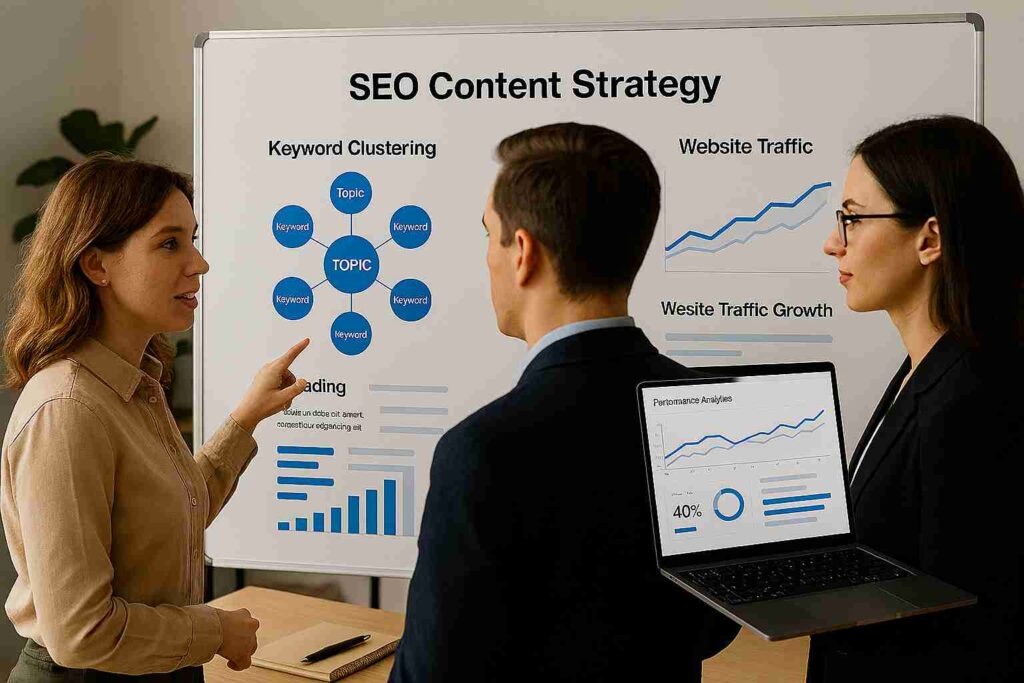
Content Strategy: The Engine Behind Long-Term SEO Growth
Publishing a single well-optimized page rarely builds sustained organic traffic on its own. Content strategy — a planned, systematic, and long-term approach to creating, publishing, and maintaining content — is what allows SEO to compound and deliver increasingly larger returns over time.
Topical Authority
One of the most important strategic concepts in modern SEO is topical authority. Google increasingly rewards websites that demonstrate deep, comprehensive expertise across an entire topic area rather than sites that publish isolated, unrelated pieces of content.
The practical application of this concept is building content clusters. A content cluster centers on a comprehensive pillar page about a broad topic — say, “what is SEO” — supported by a cluster of more specific articles that cover related subtopics in depth: technical SEO, keyword research, link building, local SEO, SEO for e-commerce, and so on. All of these articles interlink with each other and with the pillar page.
This cluster approach signals to Google that your website is a comprehensive authority on the subject, not a site that touched on it once. Over time, as the cluster builds, all pages in it tend to perform better in rankings because the authority is distributed across interconnected, mutually reinforcing content.
Content Freshness
Some content, once published, remains accurate and valuable indefinitely. Foundational definitions, historical information, and evergreen how-to guides fall into this category. Other content has a shelf life. Statistics go out of date. Tool comparisons change as products evolve. Best practice guides need to reflect current algorithm behavior.
Regularly auditing your content and updating pages that have become stale is an important part of SEO maintenance. Google rewards content that is actively maintained and reflects current, accurate information — especially for topics where recency matters to the user.
Content Gap Analysis
One of the most reliable growth strategies in SEO is identifying topics that your competitors rank for that you have not yet covered. This is a content gap. Filling these gaps systematically — starting with the highest-value, most achievable opportunities — gives you a steady pipeline of content that has demonstrated demand and realistic ranking potential.
Local SEO: Ranking Where Your Customers Are
If your business serves customers in a specific geographic area — a city, a region, a neighborhood — local SEO operates as its own distinct discipline within the broader SEO landscape.
When someone searches for “dentist near me,” “best pizza in [city name],” or “plumber [neighborhood],” Google surfaces a different type of result: the local pack, a map-based result showing three businesses with their ratings, address, hours, and contact information. Appearing in that local pack is often more valuable than ranking in the standard organic results below it.
Google Business Profile
Your Google Business Profile (previously known as Google My Business) is the single most important asset for local SEO. It controls how your business appears in Google Maps and in the local pack results. Claiming and fully optimizing your profile is the first step every local business should take before any other SEO effort.
Optimization means ensuring your business name, address, and phone number are completely accurate. It means selecting the correct primary category and any relevant secondary categories. It means uploading genuine, high-quality photos of your location, products, and team. It means actively responding to every review — positive or negative — in a timely, professional manner. It means using the Posts feature to publish updates, offers, and events. And it means proactively answering questions in the Q&A section before customers need to ask them.
NAP Consistency
NAP stands for Name, Address, and Phone Number. Consistency in how this information appears across the internet matters for local SEO. If your business name is abbreviated differently on different platforms, or your address is formatted inconsistently across directories, Google’s local algorithm may not be able to confidently consolidate this information and attribute it to your business accurately.
Audit your NAP information across major business directories, data aggregators, and any industry-specific platforms and ensure it matches your Google Business Profile exactly.
Local Reviews
Reviews are a significant local ranking signal. The volume, recency, and overall rating of your reviews influence your position in local pack results. More importantly, they are often the deciding factor for a potential customer choosing between you and a competitor.
Developing a consistent, ethical process for requesting reviews from satisfied customers — through follow-up emails, a link in your confirmation messages, or a simple in-person request — is one of the highest-impact activities a local business can undertake.
SEO for E-Commerce: The Unique Challenges and Priorities
E-commerce SEO involves challenges that content-focused websites do not face at the same scale. With potentially thousands of product and category pages, technical and structural decisions compound in their impact very quickly.
Category Pages Are Your High-Value Assets
For most e-commerce sites, category pages — the pages that list products within a specific category — are the highest-value pages for organic rankings. They target broader, higher-volume keywords. Yet they are frequently neglected in favor of optimizing individual product pages.
Each category page should have a unique, optimized title tag and meta description. It should include a substantive, genuinely helpful introductory paragraph or description above or below the product grid — not generic filler text, but content that helps the user understand what they will find and helps search engines understand the context of the page.
Managing Duplicate Content
E-commerce sites are prone to duplicate content issues. Product variants — the same product in different colors, sizes, or configurations — often generate multiple near-identical URLs. Faceted navigation, where users can filter products by attributes, can generate exponentially large numbers of URL combinations with near-identical content.
The standard solution for product variants is to choose one canonical URL per product and ensure that all variant URLs point to it using a canonical tag. For faceted navigation, a combination of canonical tags, robots.txt rules, and careful URL parameter management helps manage which pages search engines crawl and index.
Product Schema Markup
Implementing structured data markup on product pages using Schema.org vocabulary enables rich results in Google’s search listings — price, availability, review star ratings, and other details displayed directly in the search result. Rich results typically earn higher click-through rates than standard results because they provide more immediately useful information.
Site Speed Is a Conversion Multiplier
E-commerce sites should prioritize page speed even more aggressively than content sites. Research across the industry consistently demonstrates that conversion rates drop measurably with each additional second of page load time. Slow sites do not just rank lower — they convert lower. Every improvement to site speed on an e-commerce site simultaneously improves SEO performance and direct revenue.
Common SEO Mistakes That Hold Businesses Back
Understanding what not to do is as valuable as understanding best practices. These are the mistakes that most commonly prevent businesses from seeing the results they are working toward.
Targeting keywords with no realistic ranking chance. Competing for high-volume head terms dominated by established authority domains with a brand-new site is an exercise in frustration. New sites should start with lower-competition, specific long-tail keywords and build from there.
Publishing content that does not match search intent. If every result on the first page for your target keyword is a detailed educational guide and you publish a product page, you will not rank. Matching content format and purpose to intent is non-negotiable.
Ignoring technical SEO. Content quality improvements built on top of a website that has crawlability issues, slow load times, or mobile problems will consistently underperform. Fix the foundation first.
Buying backlinks. This is a direct violation of Google’s spam policies. Sites caught engaging in link schemes face manual penalties that can remove them from search results for extended periods. The short-term gain is not worth the long-term risk.
Treating SEO as a one-time project. SEO is ongoing maintenance and continuous improvement, not a single campaign. Algorithm updates, competitor activity, content freshness, and changing user behavior all require constant attention.
Not tracking the right metrics. Traffic volume alone is a vanity metric. What matters is whether that traffic converts — whether visitors become leads, customers, or subscribers. Track keyword rankings, organic clicks, and conversion rates from organic traffic together to understand actual performance.
Publishing content too thin to compete. A 300-word blog post competing against comprehensive, in-depth guides on the same topic will not rank. If a topic is worth targeting, it is worth covering properly.
Measuring SEO Success: The Metrics That Actually Matter
SEO performance is multi-dimensional. Relying on a single number gives you an incomplete and often misleading picture of what is actually happening.
Organic Traffic is the total number of sessions arriving at your site through unpaid search results. Track this monthly and compare it year-over-year to understand your long-term growth trajectory. Also track it at the landing page level to understand which specific pieces of content are driving the most visits.
Keyword Rankings tell you where your pages appear in search results for your target keywords. Rankings fluctuate daily due to algorithm activity, so evaluate 30-day trends rather than reacting to day-to-day movements. Prioritize monitoring rankings for keywords with high commercial or strategic value.
Click-Through Rate (CTR) is available in Google Search Console and tells you what percentage of people who saw your page in search results actually clicked on it. A low CTR despite high impressions usually indicates a weak title tag or meta description — the content of the page itself may be fine, but the way it is presented in results is not compelling enough to earn the click.
Conversion Rate from Organic Traffic is ultimately the metric that ties SEO to business outcomes. Set up goal tracking in Google Analytics 4 to measure how many organic visitors become leads, customers, subscribers, or take any other intended action. Traffic that does not convert to business value is nice but not sufficient justification for investment.
Core Web Vitals Scores should be monitored regularly in Google Search Console. These directly affect both rankings and user experience. Aim for “Good” ratings across all three metrics on all major page templates.
Backlink Profile Growth — tracked through tools like Google Search Console’s Links report, Ahrefs, or Semrush — shows you whether your authority-building efforts are producing results. Track both the number of referring domains (unique sites linking to you) and the quality and relevance of those linking domains.

Voice Search and AI-Powered Search Optimization
Search behavior is changing in ways that have real implications for SEO strategy. Voice search through assistants like Siri, Alexa, and Google Assistant tends to use more conversational, question-based phrasing. Instead of typing “SEO beginners guide,” a voice user is more likely to ask “how do I get my website to show up on Google?”
Optimizing for voice means writing content that directly and conversationally answers natural language questions — not just targeting stripped-down keyword phrases. FAQ sections, direct definition paragraphs, and numbered how-to steps all tend to perform well in voice search contexts because they provide clear, self-contained answers.
Google’s AI Overviews — the AI-generated answer summaries that appear at the top of many search result pages — represent another important evolution. These summaries pull from pages that are clearly structured, factually authoritative, and comprehensive in their coverage of a topic. To maximize the chance of your content being included in AI Overview summaries, focus on clear section structure, direct and concise answers to core questions within each section, factual accuracy, and comprehensive topical coverage. The same qualities that make a page excellent for human readers tend to make it excellent for AI summary inclusion.
How Long Does SEO Take to Show Results?
This is the most common question new SEO practitioners ask, and the answer requires context.
For a new website with no existing authority, in a moderately competitive niche, publishing consistent quality content and building links steadily, visible ranking improvements typically begin to appear between three and six months. Meaningful, material organic traffic growth is more realistically a six to twelve month journey.
For an established website with existing authority that begins implementing SEO improvements — fixing technical issues, improving content quality, accelerating link acquisition — results can come faster because the foundation is already there.
For highly competitive industries — legal, finance, health, insurance — ranking for primary commercial keywords can take two to three years or longer of sustained, serious effort.
These timelines are not reasons to delay starting. They are reasons to start immediately, because the compounding returns that begin after twelve months of consistent work are substantial. The investment made today pays dividends two years from now. Waiting another six months to begin means waiting six months longer to receive those returns.
Key Takeaways
SEO is not a single tactic. It is a discipline that combines technical foundations, content quality, and authority building into a comprehensive, long-term strategy.
The three pillars of Technical SEO, On-Page SEO, and Off-Page SEO must work together. Neglecting any one of them limits what the others can achieve.
Search intent is the lens through which every piece of content must be planned. Creating content that does not match intent is the single most common reason well-optimized pages fail to rank.
Google’s EEAT framework — Experience, Expertise, Authoritativeness, and Trustworthiness — reflects what Google is genuinely trying to reward: real expertise, demonstrated credibility, and content that users can trust.
Keyword research guides strategy by identifying demand, intent, and achievability. Long-tail keywords are the realistic starting point for most sites, especially newer ones.
Link building requires patience and a focus on quality over quantity. Earned links from credible, relevant sources are what build lasting ranking power.
SEO results compound over time. The work done today builds the foundation that delivers increasingly larger returns in the months and years ahead. Consistency and long-term thinking are the qualities that separate businesses that succeed with SEO from those that give up too early.
Frequently Asked Questions
What is the difference between SEO and SEM?
SEO refers to earning organic, unpaid rankings through content, technical improvements, and link building. SEM, Search Engine Marketing, typically refers to paid advertising in search results — Google Ads being the primary example. The two are complementary. Many businesses use SEM for immediate traffic while building organic rankings through SEO simultaneously.
How long does SEO take to work?
Most websites begin seeing meaningful ranking improvements between three and six months of consistent SEO effort. For new domains in competitive industries, twelve months is a more realistic timeline for significant organic traffic growth. The timeline depends on the authority of your domain, the competitiveness of your target keywords, the quality and quantity of content you publish, and the rate at which you earn backlinks.
Is SEO still worth it in 2025?
Yes, without question. Organic search remains the largest source of traffic on the internet. Google processes billions of queries every day, and the vast majority of clicks go to organic results rather than paid ads. The nature of search is evolving — AI Overviews, voice search, and conversational AI platforms are changing how answers are surfaced — but the fundamental principle of needing to be discoverable when people search for what you offer has not changed and shows no sign of changing.
What is keyword stuffing?
Keyword stuffing is the practice of forcing target keywords into content unnaturally and excessively in an attempt to manipulate rankings. It damages readability and violates Google’s spam policies. The correct approach is to use keywords naturally in context — if your content genuinely covers the topic, the keywords will appear where they belong without any need to force them.
Do I need to know coding to do SEO?
Not for the majority of SEO work. Content creation, on-page optimization, keyword research, and content strategy all require no coding ability. A basic understanding of HTML — how title tags, meta descriptions, header tags, and canonical tags work — is helpful but not mandatory. Modern content management systems like WordPress handle most of the technical markup through plugins. Deeper technical SEO work — site architecture, crawl optimization, structured data implementation — often benefits from developer collaboration.
What is a backlink and why does it matter?
A backlink is a hyperlink from another website pointing to a page on your site. Search engines treat backlinks from credible, relevant sites as votes of confidence for your content. Pages with strong backlink profiles from authoritative sources tend to rank more easily and more durably than pages without them. Not all backlinks are equal — relevance, authority, and placement on the linking page all affect the value of any individual link.
What is Google Search Console and should I use it?
Google Search Console is a free tool provided by Google that allows website owners to monitor how their site appears and performs in Google Search. It shows which queries your pages are appearing for, how many clicks and impressions they are earning, which pages are indexed or have errors, and performance data on Core Web Vitals. Every website with any SEO interest should have Search Console configured. It is the most direct window into how Google sees your site.
What is the difference between white hat and black hat SEO?
White hat SEO means following search engine guidelines — earning links naturally, creating quality content, improving user experience, and building authority honestly. Black hat SEO means using manipulative tactics that violate those guidelines — buying links, cloaking content, keyword stuffing, and other schemes designed to game rankings. Black hat tactics sometimes produce short-term gains but consistently result in penalties or algorithmic demotions that are difficult to recover from.
How does Google decide which pages to rank first?
Google’s ranking algorithm evaluates hundreds of signals for every query. The most significant include how well the page’s content matches the user’s search intent, the quality and authority of the content itself, the page’s performance on technical and experience metrics like Core Web Vitals, the strength of the page’s and domain’s backlink profile, and the EEAT signals the page and its author demonstrate. No single signal determines position in isolation — it is the combined weight of all these factors, compared against every other page competing for the same query, that determines where a page ranks.
Can I do SEO myself or do I need to hire someone?
Many elements of SEO are learnable and executable without professional help. Content creation, on-page optimization, keyword research, and basic technical checks are all accessible to a motivated business owner willing to invest the time to learn. For businesses in highly competitive markets, with complex technical challenges, or with limited time to invest in learning and execution, working with an experienced SEO professional or agency accelerates results significantly and helps avoid costly mistakes. A hybrid approach — handling content internally while hiring specialists for technical audits and link acquisition — works well for many small and medium-sized businesses.
References & Resources
Google Search Central Documentation — The official resource for all technical SEO guidelines, crawling and indexing documentation, spam policies, and structured data references. Available at developers.google.com/search/docs.
Google Search Quality Rater Guidelines – The official document outlining how Google trains its human evaluators to assess page quality, including the full EEAT framework. Available through Google Search Central.
Google PageSpeed Insights – Free tool for measuring Core Web Vitals and page performance. Available at pagespeed.web.dev.
Google Search Console Help Center – Complete documentation for using Google Search Console. Available at support.google.com/webmasters.
Google Analytics Help Center – Documentation for setting up and using Google Analytics 4. Available at support.google.com/analytics.
Moz Beginner’s Guide to SEO – One of the most widely referenced introductory resources for SEO fundamentals. Available at moz.com/beginners-guide-to-seo.
Ahrefs SEO Blog – Comprehensive research-backed articles covering all aspects of SEO. Available at ahrefs.com/blog.
Search Engine Journal – Industry news, guides, and research covering search and digital marketing. Available at searchenginejournal.com.
Search Engine Land – News and analysis covering search engine algorithms, industry updates, and best practices. Available at searchengineland.com.
Schema.org – The official reference for structured data markup vocabularies used in SEO. Available at schema.org.
Web.dev Core Web Vitals Reference – Google’s official technical documentation on Core Web Vitals measurement and optimization. Available at web.dev/vitals.
Published by Rank Executor | This guide is for educational purposes. All SEO practices should be implemented in accordance with Google’s current Search Essentials and Spam Policies.